 |
| "Into Violet" |
Tags: Naturalistic Photography, Low-light Photography, Parts of Things, Grass, Purple

|
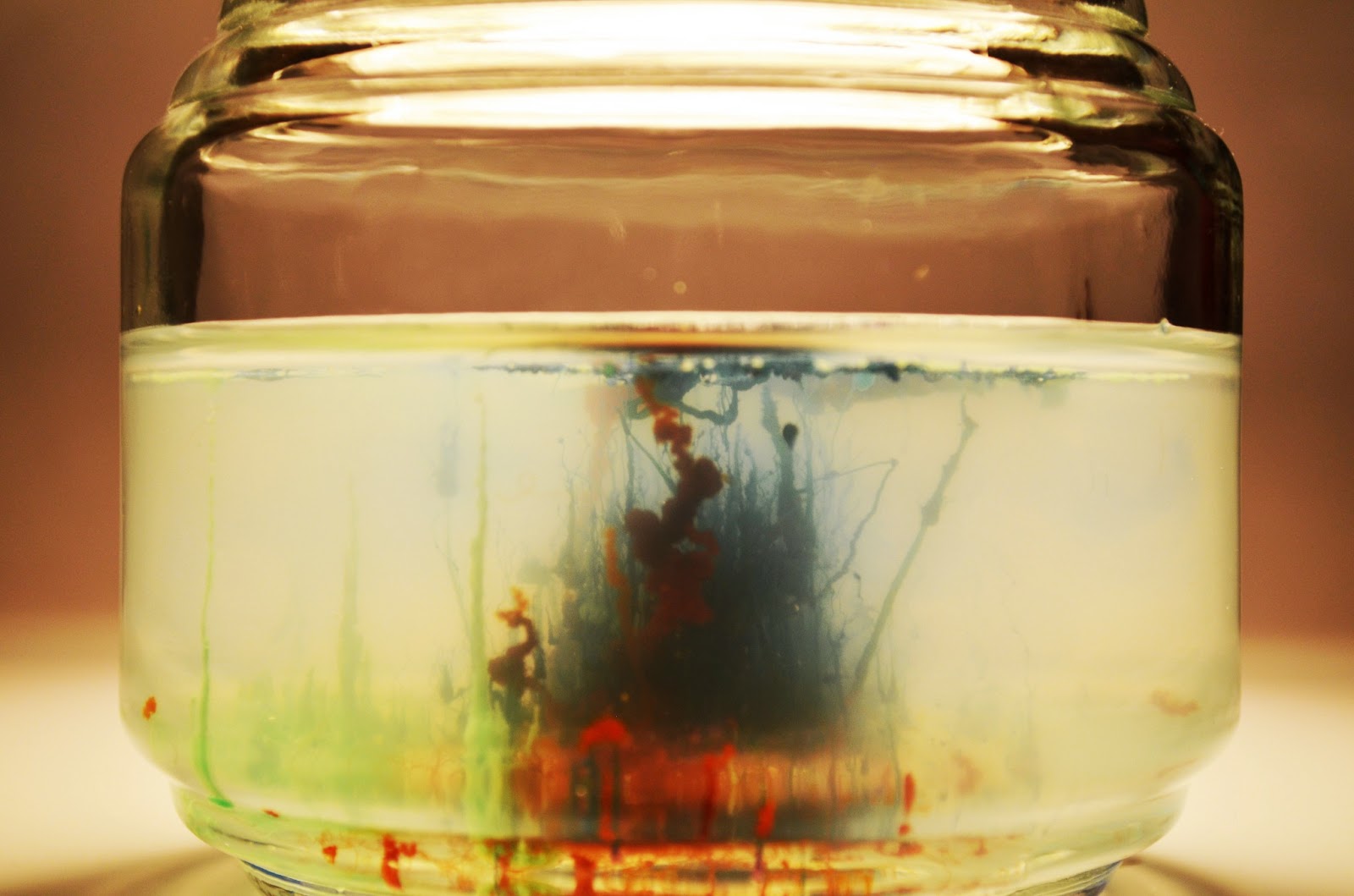
| "Into Violet" |
In a solution of 50/50 sodium silicate (Na2SiO3) and distilled water, added clumps of metal salts (IE: copper (II) sulfate, cobalt (II) chloride, nickel (II) sulfate, etc) will begin to "grow" in the same nature as plants or stalagmites.
Essentially, the metal salt, once added to solution, will start to dissolve in water. It will then form an insoluble metal silicate, which acts as a semipermeable membrane. Now, because the metal solution inside the membrane has a greater ionic strength than that of the sodium silicate solution, osmotic effects will cause pressure to build in the membrane, eventually forming a tear. The metal cations, then, will begin to interact with the silicate anions in a manner identical to the original, insoluble-metal-silicate-forming process (forming more solid structures!). During this particular event, typically, the pressure at the bottom of the container is greater than the pressure at the top, thus enticing the plant-like structures to go grow upward.
Of course, one may theoretically exploit the characteristics of chemical gardens! For example, the density of the "fluid" contained in the membrane dictates the direction of growth for these delicate structures. The concentration, moreover, of the sodium silicate in the solution overall is responsible for the rate of growth, as well.
There are various applications for these chemical oddities, anywhere from the examination of hydrothermal vents (the chemistry between both concepts are very closely related), to the origins of life on earth. If you aspiring scientists have any free time, I highly suggest researching these topics. They are very, very interesting reads.
 |
| Tumblr Hi-Res Link! |
 |
| "Melancholy Gardens" |
 |
| "Heart" [Click for Hi-Res!] |
 |
| "Inside my Genes" [Click for Hi-Res!] |
 |
| "You Got It" [Click for Hi-Res!] |
 |
| "Overload" [Click for Hi-Res!] |
 |
| "Connected" [Click for Hi-Res!] |
 |
| "Toth" [Click for Hi-Res!] |
 |
| "Ruby" [Click for Hi-Res!] |
 |
| "Weirdo" [Click for Hi-Res] |
 |
| "The SIBS" [Click for Hi-Res!] |
Once in the container, water will sink to the bottom and push oil to the top because water (in terms of density) is heavier than the veggie oil. They do NOT mix. Agitating the mixture at this point may break up the oil into droplets, which will eventually reform into the oil (top) layer.
In water, Alka-Seltzer tablets (specifically, sodium bicarbonate and citric acid) will react and form sodium citrate, water, and carbon dioxide gas. The bubbles produced may take water molecules/food coloring bubbles up when they rise through the oil, but when they pop at the surface said water molecules/food coloring bubbles will sink back down once more.
You can cap the container after the CO2 gas leaves, and then store for later use. (:
Once in the container, water will sink to the bottom and push oil to the top because water (in terms of density) is heavier than the veggie oil. They do NOT mix. Agitating the mixture at this point may break up the oil into droplets, which will eventually reform into the oil (top) layer.
In water, Alka-Seltzer tablets (specifically, sodium bicarbonate and citric acid) will react and form sodium citrate, water, and carbon dioxide gas. The bubbles produced may take water molecules up when they rise through the oil, but when they pop at the surface said water molecules will sink back down into their respective water layer.
With regards to Tonic Water, a sample will glow bright blue when hit with UV light due to the presence of quinine. When UV light hits this particular molecule (baring a delocalized aromatic system with delocalized electrons), it excites an electron and when it subsequently falls down back into its ground state, it releases a photon (and thus being fluorescent in UV light)Pretty neat, huh? Here's a picture capturing one of the "violent" reactions:
 |
| Tumblr Hi-Res Link! |

Here it is folks! My first EVER Chemistry experiment on this blog (first attempt at a lava lamp).
What you see here, is the combination of 70% isopropyl alcohol, distilled water, tonic water, veggie oil, and droplets of green and blue glow stick solution. After mixing, I introduced several pieces of an alk-seltzer tablet into to reaction flask to induce fizzing. It's by no means perfect, considering the fact that the "lava" primarily exists on the top layer of the solution, being fully separated.
Also, it should be noted that I wasn't after formation of an actual lava lamp, this first time around. I just wanted to test and assess the effects of adding these chemicals together, and observing the effects that would ensue post addition of the alka-seltzer tablet to the solution in question.
Tonic water glows bright under black light (based on the concentration of quinine), and particles from the glow stick will glow under black light as well, but neither will glow to the naked eye under normal light conditions (especially for the glow stick solution samples introduced to the water/alcohol layer in the "lamp").
When you agitate this mixture, bubbles will form, layers will flop, smash together, and reform based on density, and so on. I aim to capture portions of the experiment that I find relatively interesting, and would like to share with you all. That is what these posts will generally be about.
To me, the science of Chemistry is an art. And I will attempt to "capture" these glimpses of art via photography.
I'll post some of the pictures I took during this process soon after this post, and will continue to do so throughout the day/week. I'll be doing more experiments as well, and eventually hope to perfect an actual lava lamp.
OH! And one last thing: to the aspiring chemists who may read this blog, please perform these experiments with eye protection (ESPECIALLY after adding the alka-seltzer tablet) and hand protection. If you're not big on utilizing stoichiometry and understanding how to base proportions of adding chemicals with respect to your container, you're going to make a mess. Just remember to be careful, and make sure you have some rags around. Some of these chemicals WILL stain.
In the meantime, enjoy your self. (:
- Christian
 |
| Tumblr Hi-Res Link! |


